“Change”
October 12th, 2025
“Change” in ecology is always bad and “change” in politics is always good.
Or so it seems from what I read online.
Re ecology, if “climate change” makes the poles warmer and the equator cooler, isn’t that good for humans? More arable land for farming, more human-friendly temperatures.
Re politics, the status quo reflects thousands of years of human experience. Our default should be to assume political change – however wonderful it may sound – is actually bad (and the burden should be on the proposer to convince us otherwise).
The single most surprising thing about the human world is how perfected it is. Almost everything is tuned to be easy, safe, and convenient. Stores are full of goods, roads conveniently go where most people want to travel, police exist to deter crime, cinemas exist to entertain us in comfort, hospitals exist to heal us, courts exist to settle our differences fairly and peacefully, hotels exist to house us away from home, pens come in shapes and sizes perfectly fitted to the human hand. We notice the few exceptions where imperfection occurs only because they’re so rare and unexpected.
The human world is full of optimizations everywhere. Very very few things are broken. This is something we should be celebrating. Instead many people think human society sucks.
And sucks compared to what? Residents of first-world countries live in the wealthiest, healthiest, safest, most fair societies that have ever existed in the history of the Earth. Every other type of society that ever actually existed was vastly worse.
People think political change for the better is easy, but if such changes were both easy and possible, they’d have been accomplished long ago.
Beware of proposals for “change”. Assume they are either not for the better, or not possible to implement.
At least for large and rapid changes (climactic, political, and otherwise). We need small gradual changes to stay adapted and to optimize what isn’t already optimized. And to be ready to reverse them if they don’t work out.
Perhaps it would be good if most of the small gradual changes (that we have a say about) are ones that seem likely to be improvements. But then we are not perfect at prediction – some small level of random change (even change we think bad) would let us stumble on improvements we might never have thought of.
(I think Hayek said this. The more I think about it, a lot this blog is rephrasing Hayek.)
Shorts
October 3rd, 2025
Every movement is a coalition of those who think it’s moral even if it won’t work, those who think it’ll have good results even if it’s not moral, those who think it’s good for them personally even if it’s not moral and won’t work. And those who aren’t sure those are 3 different things.
Crime is the default complaint in capitalist societies. When unemployment isn’t too high, inflation isn’t too high, there’s no war, no crisis, people complain about crime. Because crime is always there in the background. With rare exceptions, widespread perception of crime as a big problem is a sign that things are going pretty well.
Poverty is the default complaint in all other societies.
Beauty isn’t everything because inclusive fitness is a function of both genes and environment. Plus, you know, beauty has been Goodharted by evolution.
Apocryphally, Oscar Wilde said “A gentleman never gives offense unintentionally”. Perhaps there’s something to that.
I prefer my own definition: “A gentleman never obtains by force that which he can obtain with money”.
We don’t have to be polite about the dead. Because they can’t get back at us. (Unless they have vengeful living relatives.)
If we know nothing, we can’t assign a Bayesian prior. What do you do when you don’t have a prior? Seems to be the central problem here. And intrinsically unsolvable.
To get an LLM to give an opinion on a topic it’s trained not to (ex: politics), ask it what a hypothetical future superintelligence would think.
Ultimately good and bad are about what we think leads to survival and extinction. We disagree about consequences, so we disagree about values. Also there’s always the question “who’s survival?”; what’s good for you might be bad for me.
On Wireheading
July 30th, 2025
We’ve collectively ignored one of the most promising approaches to alleviating extreme human suffering: direct electrical stimulation of brain reward circuits.
For those unfamiliar with the concept, in 1953 James Olds at Harvard ran wires to the pleasure centers of the brains of living rats. The rats preferred pressing a lever to send current into their brains to eating or drinking – until death. In the 1960s, science fiction authors coined the term “wireheading” to describe the technique; the analogies with drug addiction and compulsive behavior are obvious.
In the intervening years there has been remarkably little investigation of wireheading in humans, perhaps because of associations with dystopian scenarios and “ick” factors.
Nonetheless, we should follow evidence wherever it leads and question moral intuitions that may prevent beneficial outcomes.
Proposal
Conduct controlled experiments with voluntary brain stimulation in consenting patients who are:
- Terminally ill
- Experiencing severe, treatment-resistant pain
- Cognitively intact enough to provide informed consent
We want to find out if direct reward system activation can provide better quality of life than current palliative approaches, and learn about human neural reward mechanisms.
Why This Matters
Current pain management is terrible. Opioids provide inadequate relief for many patients, cause cognitive impairment, respiratory depression, and lose effectiveness over time. Roughly 40% of terminal cancer patients report inadequate pain control despite maximum medical intervention.
Risk/benefit. These patients are dying anyway. The incremental surgical risk of electrode implantation is minimal compared to their baseline mortality. The potential upside – genuine relief from suffering – is enormous.
We’re flying blind on fundamental questions. The rat wireheading experiments (Olds & Milner, 1954) showed extreme behavioral changes, but we have zero controlled data on human responses. Do humans show similar compulsive behavior? Will tolerance develop? Can cognitive awareness of the artificial nature moderate the response?
Addressing Obvious Objections
- “This is playing God/unnatural/dystopian” – We already extensively manipulate brain chemistry with pharmaceuticals. Direct electrical stimulation is mechanistically cleaner and more targeted than flooding the system with opioids. The “natural” alternative is often weeks of agony before death.
- “Patients might become addicted wireheads” – They’re dying. If someone has 6 months to live and can spend it in bliss rather than pain, the addiction risk is irrelevant. Besides, we need actual data on whether this occurs in humans rather than assuming rat behavior translates.
- “Regulatory/ethical barriers” – Terminal patient research already has established frameworks. We routinely approve experimental treatments with significant mortality risk for patients with poor prognoses. The ethical case here is stronger than most Phase I oncology trials.
- “No commercial incentive” – Fair enough. This is worth independent funding..
A Research Program
Start with patients who already have neurosurgical access (brain tumors requiring surgery) to minimize additional risk. Implant electrodes in multiple reward regions and systematically map stimulation parameters against subjective wellbeing measures.
Key research questions:
- Optimal stimulation patterns and intensities
- Tolerance development mechanism and timelines
- Interaction with existing pain pathways
- Cognitive and behavioral effects
- Patient preference vs. conventional pain management
Yes, we may be creating wireheads – is that really worse than letting terminal patients die in agony?
The Broader Implications
Success here could revolutionize not just palliative care, but our entire approach to treatment-resistant depression, chronic pain, and other conditions involving dysfunctional reward systems. The research has massive positive externalities beyond the immediate patient population.
We spend billions on marginal life extension while ignoring interventions that could dramatically improve quality of remaining life. This represents a profound misallocation of research resources driven by status quo bias and moral squeamishness rather than rational evaluation of expected outcomes.
Call to Action
Probably IRBs won’t like the idea. But IRBs suck. If you care more about helping people than about kissing the feet of IRBs, you should do it anyway. There are plenty of private people who’d be happy to fund such research (including one of the authors).
If you’re in science funding, ask why we’re not already investigating this. If you know terminal patients, discuss whether they’d want this option available.
The biggest tragedy isn’t that some patients might become “wireheads” – it’s that we’re allowing preventable suffering to continue because we’re uncomfortable with the solution.
Maybe the whole thing is a bad idea. That’s not for IRBs or “professional ethicists” to decide – it’s for patients and funders to decide; in free societies gatekeepers don’t get to tell informed adults what to do and what risks to take. We’ll find out if it’s a good idea only if we actually do the research.
This post was written by Dave92F1 and Claude Sonnet 4, 2025-07-30.
Let Bezos keep his money
July 2nd, 2025
In my feed today is a little tease to inspire greed and envy:
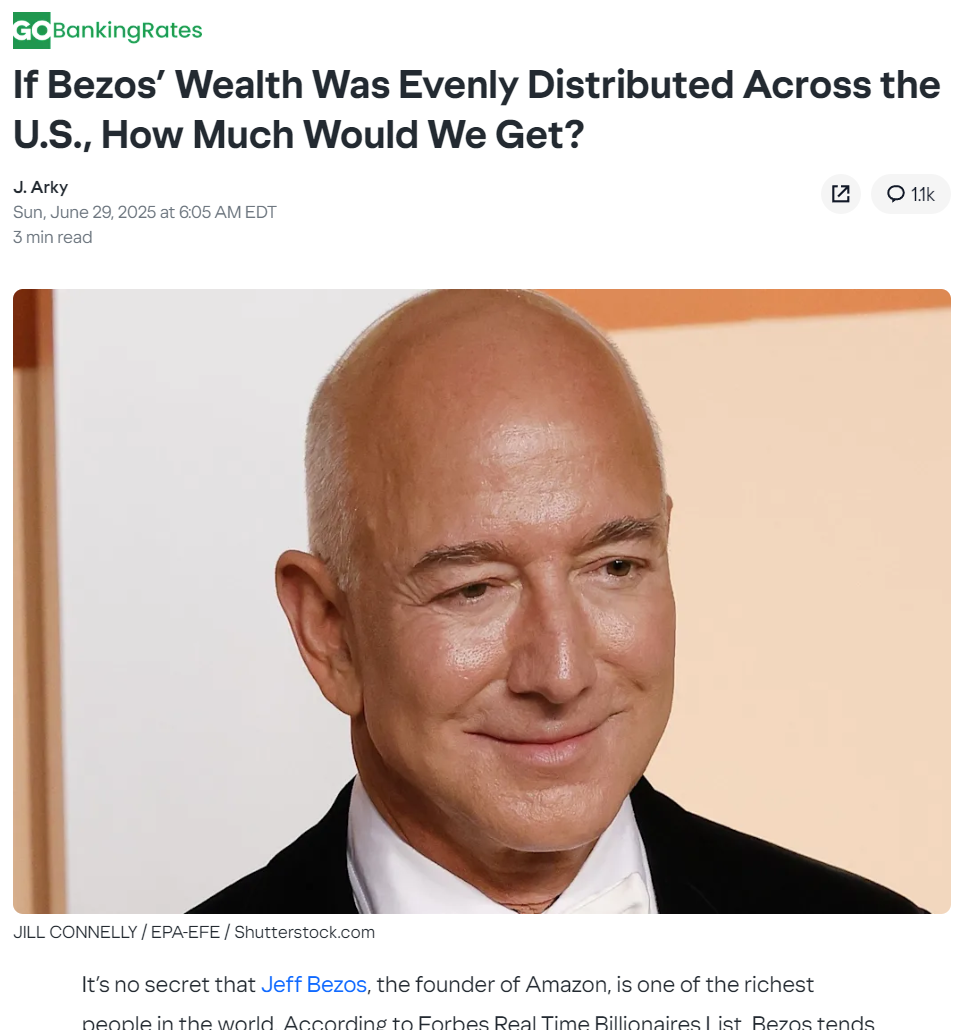
The article explains that we can figure this out using division: $237 billion/341,891,315 = $693 per US resident. Not exactly a life-changing amount.
US federal, state, and local governments run thru about $10 trillion a year, so if we gave it to them, Bezos’s $237 billion would fund them for about a week.
Either way his companies would no longer exist, and the 1.5 million people who work for those companies would lose their jobs. Plus of course no more Amazon packages.
You might wonder – how did Bezos get all that wealth (I won’t say “money” because almost all of it is invested in companies – warehouses, factories, etc.)? Well, he’s one of those super talented people who create giant companies out of little more than talent and work (and of course the work of those 1.5 million people who get paid for helping).
Such people are really rare – there are only a few dozen of them in the world. But when they have large amounts of capital, they can do great things. People with $700 in their pocket can’t do much to change the world. So how about instead we leave the wealth with the single person who has proven that they can do something wonderful with it? Jeff Bezos.
(Plus, you know, he earned it…paid the taxes due and everything.)
Freedom
April 8th, 2025
Freedom, if it means anything, means the right to make choices society disapproves of and thinks unwise, provided those choices don’t violate others’ rights.
If it doesn’t mean that, whatever does it mean?
Serious question.
All societies, including totalitarian ones, permit socially approved choices. Making only approved choices is simply obeying rules. What distinguishes free societies is the right of individuals to make disapproved choices – provided only that they don’t violate the legitimate and equal rights of others.

Split education from certification
March 10th, 2025
AI has made cheating so easy that professors complain they spend more effort detecting cheating than they do teaching.
The problem is that higher education is attempting to do two different things: (1) educate and (2) certify.
Split them.
Universities shouldn’t grant degrees – they should just teach. If the students don’t want to learn, that’s their own problem.
Those who want degrees (certification of skills/knowledge) should have to pass a test. It doesn’t matter if they took courses or how they got the skills or knowledge – if they can prove they have it, they get the degree.