Why English majors vote socialist
August 11th, 2026
Jay Sophalkalyan has a post on Substack pointing out that in the 2025 NYC mayoral race:
Andrew Cuomo performed better among New Yorkers without a college degree. Among voters with bachelor’s or graduate degrees, by contrast, Mamdani defeated him by nearly 20 points.
…and goes on to argue that education is no defense against fanaticism, drawing from the experience of his native Cambodia and the genocidal Khmer Rouge.
He’s not wrong, but perhaps worries too much. People with humanities degrees (which carry some prestige but little value for earning a living) have always been critics of free markets. They don’t like the result.
When in school, they were promised that because they were smarter than the others, worked hard, and graduated from a prestigious university, they’d end up at the top of society. But markets reward pro-social activity – providing things that others want to pay for. University equipped them to produce art and literary criticism, but there’s not much demand for that, and too many people wanting to sell it. So these people don’t make much money, and blame “capitalism”.
As Randy Newman put it in It’s Money That Matters (1988):
Of all of the people that I used to know
Most never adjusted to the great big world
I see ’em lurking in bookstores
Workin’ for the public radio
Carryin’ their babies around in sacks on their backs
Movin’ careful and slow[Chorus]
It’s money that matters
Hear what I say
It’s money that matters
In the USA[Bridge]
All of these people are much brighter than I
In any fair system they would flourish and thrive
But they barely survive
They eke out a living
They barely survive
These people aren’t starving, but neither are they running the world. They feel cheated – teachers and schools led them to feel entitled to rewards for what teachers and schools value in students – hard work plus obedience plus cleverness. But the adult world doesn’t really want that – mostly it wants goods and services. Under socialism, once the money-grubbing makers and doers and, worst of all, merchants, are ground into the dirt, they will be elevated to their rightful place. They will run the world.
It hasn’t actually worked out that way anywhere socialism has been tried, but they majored in English, not history.
Contra Jen Cole Wright re extreme wealth
August 9th, 2026
Jen Cole Wright, a professor of psychology at the College of Charleston, has a piece this week, The moral paradox of extreme wealth: Why people oppose it yet are reluctant to take steps to reduce it, in The Conversation, another online publication seemingly fearful of criticism, as it has disabled comments.
So my comment is here. I’ll keep it short.
Wright starts by confusing wealth (she talks about Elon Musk as a trillionaire) and income (surveys about what people in various positions ought to earn). What people earn for their labor is an entirely different thing from investment value. Wages are the result of market supply and demand for skills, ability, and effort. Investment values are stocks of value, not flows of value. The survey evidence she cites is about pay ratios, yet she uses it to support claims about wealth. Whether a wage is “fair”, independent of supply and demand, has nothing to do with the value of industrial enterprises such as Mr. Musk’s car and rocket factories, and how that value depends on investor decisions. This is not a “moral problem”.
Second, she mischaracterizes “libertarian morality” by claiming it focuses on the degree of harm necessary to justify state intervention. It does not – libertarian morality focuses on who is harmed, not the degree of harm. As J.S. Mill pointed out, the essence of freedom is the ability to make unpopular choices, provided that the consequences fall on the chooser. Individual circumstances differ, and actions that are harmful in some circumstances may be beneficial in others – libertarians allow competent adults to take their own gambles and win or lose accordingly. Per Mill, restrictions are acceptable only to prevent harm to third parties, not to paternalistically prevent adults from taking their own risks.
And she links to Iyer et al, which contradicts her. Iyer did not find libertarians drawing a line at a different degree of harm. It found that libertarians value liberty while showing “weaker endorsement of all other moral principles,” with a more cerebral, less emotional style. That is a different moral architecture, not a difference of calibration.
Probably her most effective argument is that extreme wealth can lead to political power, which may be used to entrench relative positions of wealth. There’s an entire academic field devoted to studying this – Public Choice – of which she seems unaware. To the extent the wealthy persuade voters via media they control, that is because voters are convinced by the arguments made; their votes have not been purchased. If the wealthy instead buy influence with officials, the returns scale with the discretionary favors the state has to sell, and so argues for limitations on government power.
Despite The Conversation’s claimed “Academic rigor, journalistic flair”, they’ve made the cowardly decision to disable comments. I try to do better. I’m sending a link to this post to Professor Wright, and invite her to reply.
We know markets are wrong.
We just think they work.
May 5th, 2026
…or, why would anybody do anything if there were nothing to be gained by it?

Most people deep down think Benjamin Franklin was right when he wrote:
Finally, there seem to be but three Ways for a Nation to acquire Wealth. The first is by War as the Romans did in plundering their conquered Neighbours. This is Robbery. The second by Commerce which is generally Cheating. The third by Agriculture the only honest Way; wherein Man receives a real Increase of the Seed thrown into the Ground, in a kind of continual Miracle wrought by the Hand of God in his Favour, as a Reward for his innocent Life, and virtuous Industry.
[Positions to be Examined, April 4, 1769]
Most people also think commerce works, even if it’s “cheating”. Profit creates incentives, which make people behave in pro-social ways (trying to meet one another’s needs).
Franklin was wrong about commerce being “generally cheating”, but the belief goes back to our ancestors. Evolutionary psychology gives us the zero-sum idea that trade can’t be mutually beneficial. Ideas of “just price”, “true value”, the labor theory of value, profit-seeking as a base motive – all come from there. Per Claude.ai:
Confucian China placed merchants at the bottom of the four occupations (士農工商 — scholar, farmer, artisan, merchant) for two millennia. Tokugawa Japan inherited this and made it formal social policy: merchants couldn’t own land, couldn’t carry swords, couldn’t wear silk. Hindu varna placed Vaishyas (merchants) below Brahmins and Kshatriyas; Manusmriti has detailed strictures on commercial conduct that frame profit as morally suspect. Islamic jurisprudence prohibited riba (interest) and developed elaborate doctrines distinguishing legitimate trade from exploitation. Medieval Christianity condemned usury and developed just-price theory. Pre-contact African societies, pre-Columbian Mesoamerica, Polynesian chiefdoms — gift exchange and reciprocity are honored while market exchange with strangers is suspect or actively low-status.
Franklin was a businessman with a famous reputation for honesty, and should have known better from experience. Perhaps he felt guilt about engaging in base commerce.
It’s blindingly obvious that most trade can’t be cheating. People trade when both think they have something to gain from the trade – if trade is at “equal value” to each side, there’s no reason to bother with the trade. People value the same things differently – an employee values his earnings more than the leisure forgone; the employer values the labor more than the wages paid. I buy beans at the grocery store when I want the beans more than I want the price the store charges.
We trade when we expect to get more utility out of our holdings after the trade.
The economist Étienne Bonnot de Condillac may have been the first to formalize this:
“It is not true that on an exchange of commodities we give value for value. On the contrary, each of the two contracting parties in every case, gives a less for a greater value. … If we really exchanged equal values, neither party could make a profit. And yet, they both gain, or ought to gain.”
[Le Commerce et le Gouvernement Considérés Relativement l’un à l’autre (1776), Part I, Chapter 6, published the same year as Wealth of Nations. Marx quotes and attacks it explicitly in Capital Vol. I — he had to, because it’s a direct refutation of his labor-equivalence-in-exchange premise.]
Ayn Rand and Libertarianism
December 26th, 2024
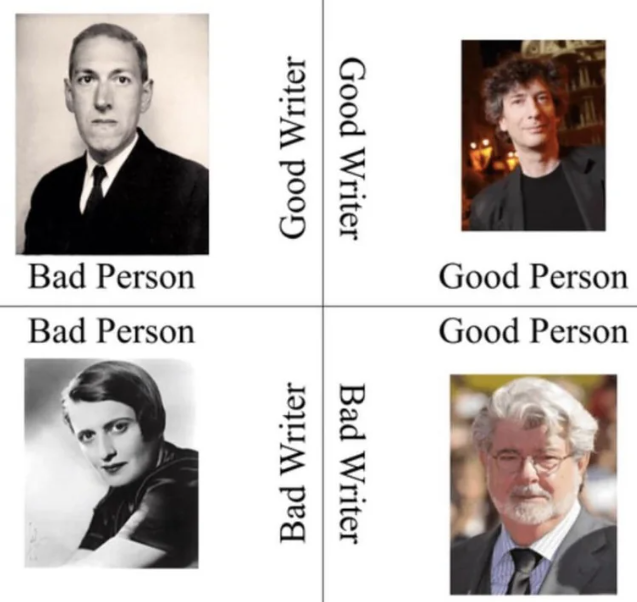
I saw the above on r/ExplainTheJoke. It’s HP Lovecraft, Neil Gaiman, Ayn Rand, and George Lucas.
I just want to talk about Rand and a reaction on Reddit.
JesusIsMyZoloft said “Bottom Left is Ayn Rand, author of Atlas Shrugged. Far-right libertarian who believes that not only should it be legal to do immoral things (the fundamental tenet of libertarianism) but that therefore you should actually do immoral things.”
It’s an interesting take on libertarianism, and maybe explains a lot of the hostility toward it.
I’m more classical liberal than libertarian these days. A commonality is the idea that freedom means being allowed to make decisions that society thinks are poor ones (yes, including re morality), provided the equal rights of others are respected. (If it doesn’t mean that, whatever does it mean?)
In practice much of this is about opposing paternalism – laws that are for “your own good”. For example libertarians think it should be legal to use an unlicensed vet to care for pets, as long as the vet doesn’t fraudulently claim qualifications they don’t have. Or buy non-FDA approved drugs. Neither has anything to do with morality.
Rand herself hated libertarians with a passion, but that hasn’t prevented her from being the patron saint of a certain subset of them.
Personally I think Rand was a pretty good fiction writer (The Fountainhead is quite good), and a terrible non-fiction writer.
Prostitution and liberty
February 14th, 2024
Happy Valentine’s Day 2024! Scott Alexander has a great post today proposing Valentine’s Day as a libertarian holiday.
Love and sex seem to me two different things. (Admittedly related things, like life and food.) Not everyone agrees. In the comments “Alephwyr” and I traded thoughts that I think capture some fundamental differences:
Alephwyr (The Dragonsphere Examiner):
Prostitution is the libertarian model for love. It’s transactional, and as a single category of behavior it obfuscates enormous differences in the power dynamics that define each case, such that trafficking or survival sex becomes grouped under the same label as call girls and others who have no plausible coercion to work.
Dave (The Mugwumpery):
We can focus on power dynamics, or we can focus on consenting adults making the best choices they can for themselves under the circumstances. I don’t think we can do both. Preventing transactions driven by power dynamics inevitably also prevents people from doing what they think is best for themselves. What most people call “freedom”.
Being able to do only things that society approves as proper is conformism. It’s fundamentally opposed to the idea of human rights – rights that allow people to make their own choices, despite the disapproval of society.
Alephwyr (The Dragonsphere Examiner):
Sure. Let’s follow that to it’s conclusion and allow child labor, pederasty, remove paternalism towards people with severe cognitive disabilities and let them fend for themselves, abolish laws requiring the use of translators in contracts between people who speak different languages since different levels of access to information are just part of the natural world and have to be accepted for the sake of freedom. Let’s stop trying to prevent old people from being scammed. In fact, the concept of a scam should be abolished as it’s too subjective; where is the line between a legitimate and illegitimate difference in knowledge?
Dave (The Mugwumpery):
I did say “adults” up there, didn’t I? I favor strong (much stronger than current) enforcement of common law fraud and legal penalties for deception of all kinds. Even legal requirements to inform people.
But requirements for honesty and information isn’t the same as prohibiting informed adults from doing what they choose to do (that doesn’t directly harm 3rd parties).
We’re not going to agree, I suspect. I’m just saying you can either prohibit transactions society doesn’t like, or you can let people make the core decisions about their own lives. You can’t do both.
Alephwyr (The Dragonsphere Examiner):
I have heard what you said and would need to see substantially more evidence to make a determination about it.
What democracy, and rights, are for
August 23rd, 2023

Democracy is popular, despite leading to public policy that doesn’t generally seem to be better (or worse) than that produced by other systems.
As is well known, pure democracy (majoritarianism) leads to tyranny at least as often as other forms of government. In a pure democracy, 51% of voters can, legitimately, torture and kill the other 49% of the population. That’s why every even moderately successful democracy has things like constitutions and “bills of rights” – there are many things even majorities should not be allowed to do, and these are necessary constraints. Some advocates of democracy don’t seem to understand that “human rights” and “democracy” are in tension – rights are things that even majorities may not infringe.
Regardless of the system of government, constitutions, or formal rights, sufficiently large majorities always get whatever they want. Because a sufficiently large majority will always win a civil war.
This unfortunate fact leads to the one really unarguable benefit of democracy – it provides a way for large majorities to get what they want peacefully via elections instead of via bloody civil war. If they’re such a large majority that they’re going to win anyway, far better for them to win peacefully.
Other than that (not inconsiderable!) benefit, I’m not sure there’s anything very good about democracy – it certainly hasn’t been shown to lead to wise governance, honest leaders, or respect for human rights.
I’m not saying citizen’s opinions shouldn’t be taken into account – only that voting directly for specific legislators and policies doesn’t seem to produce especially good outcomes. Other ways may be better.
There have been many proposals to limit or bias the franchise to improve democracy by giving extra weight to more-competent-than-average voters – for example extra votes for military service, avoidance of crime or debt, payment of taxes, marriage or child rearing, education, tests of intelligence, knowledge, or competence, etc. In the unlikely event of their adoption, these might improve the quality of elected officials and of legislation.
But if you take the point of view that democracy is mainly for keeping the peace, these attempts defeat that purpose – tax-paying university graduates with children and without criminal records are unlikely to start or participate in civil wars. Instead, there’s something to be said for limiting the franchise (or weighting votes) according to ability and propensity to make trouble. This is probably why, historically, only landowners and men were allowed to vote – penniless peasants and women didn’t make civil war very effectively. Nor children.
Rewards, incentives, and fairness
May 26th, 2017
In a comment on SlateStarCodex today the author (“leoboiko”) advocates a programme of socialism under the assumption that intelligence and ability are inherited, rather than earned, by their possessors. She said,
For one thing, this means that the idea of “meritocracy” is inherently unfair. Giving people access to wealth and resources based on their IQ-related achievements is as unfair as making people richer when they’re born taller. We would want some sort of social program to guarantee everyone access to a decent life according to their needs, not according to their abilities.
And went on to illustrate the unfairness of a world in which wealth was allocated according to height.
I do think intelligence and ability is mostly genetic, and I agree that’s unfair. My response is,
What we are rewarding (and want to reward) is success in helping society progress – materially, culturally, etc. Helping other people. Making the world a better place to live.
Our society is not meritocratic in any sense. We don’t reward merit. Or intelligence. Being meritorious, well-intentioned, hard-working, intelligent, and capable gets you…nothing. What gets rewarded (imperfectly, of course) is actually delivering the result – benefits to other people, as evaluated by those people, by their willingness to voluntarily trade wealth for those benefits.
Intelligence is associated with wealth because we reward pro-social activity, and intelligence makes success in such activity more likely. Height doesn’t (except in basketball).
Steve Jobs wasn’t wealthy because he needed it, or because he was a nice guy (he seems to have been an unpleasant person in many ways). He was wealthy because he created great things that benefited billions of people.
That’s as it should be. It’s not, and never has been, about fairness. It’s about incentives.
Without such incentives, capable people wouldn’t try very hard. And wouldn’t control large amounts of capital for use in their projects. And we all would be far worse off.
Of course I’m not claiming our society does this perfectly or consistently. There are lots of ways to cheat the system, and lots of people who become wealthy in ways other than “making the world a better place” – most obviously, monopolists, tricksters, and power brokers. I advocate fixing that.
But the basic system works. Making the world a better place to live is more important than fairness.
Stupid vs. Evil
November 5th, 2016
It is traditionally held in the United States that there are two major political parties, which can fairly be described as the “Stupid” party and the “Evil” party.
Thoughtful partisans on each side are firmly convinced that their own party is the “Stupid” party, while the opposition is the “Evil” party.
(If you think the situation is less symmetrical than that, I submit that this is an indicator of your partisanship.)
However, this is wrong.
Both parties, like the electorates that support them, and humanity in general, are about 80% stupid and 20% evil.
Free speech and the left
May 29th, 2016
What is going on with the left and free speech?
Decades ago self-described liberals were consistently in the forefront of defending the right to free speech and the first amendment.
Lenny Bruce was the poster boy/martyr for this cause. Liberals defended pornography and communists. They consistently said “the answer to speech you don’t like is more speech” – not controls on speech.
The ACLU became famous for defending unpopular speech, even to the extent of defending the right of neo-Nazis to march though the largely Jewish Chicago suburb of Skokie.
From George Orwell’s 1984 to the Berkeley Free Speech Movement to denunciations of Joe McCarthy, much of the left seemed to define itself as defending freedom of expression.

Mario Savio and FSM – UC Berkeley Sather Gate, 20 November 1964
But in recent years it seems the situation has turned 180 degrees. The #1 cause célèbre among all my left-of-center friends is reversing Citizens United. Campus protests demand censorship and “safe spaces”, and aim to drum professors advocating politically incorrect views out of the academy.
And then we have:
Arrest Climate-Change Deniers – Gawker
New Inquisition: Punish climate-change ‘deniers’ – WND.com
Al Gore at SXSW: We Need to ‘Punish Climate-Change Deniers’ and ..
Climate “Deniers” Must Be Jailed or Killed | – Acting Man
This all seems a very long way from the impassioned defense of free speech the left (in the US) used to stand for.
What happened? Why?
I asked an insightful slightly left-of-center friend, who said,
“Liberals will care about free speech if and as it fights harm and oppression and advances equality. There are a handful of people who care about free speech as an end in itself, but not many.”
I’m not sure if that’s correct. But if it is, what does that say about the contemporary left?
If the left of the 1940s, 50s, and 60s thought that free speech would advance its goals, helping to undermine the status quo, does it now oppose free speech because it sees itself in a position of power, able to dictate what are and aren’t acceptable ideas?
When and how did that change? Did the fall of the Soviet empire strengthen the left in the west, instead of discrediting it?
I’m confused. But as someone who really does care about free speech, it’s terribly disappointing.
Grandpaw’s axe cut the ship of Theseus
September 22nd, 2014
Or, Why I Have No Use for Philosophers
This is my grandfather’s axe. My father replaced the handle, I replaced the head. This is my grandfather’s axe.
Every time I try to discuss anything of substance with a professional philosopher, and often even with someone trained in philosophy, I find myself in an argument over semantics – the meaning of words.
I think this is why philosophy is generally held in such low regard.
The Ship of Theseus is a more elaborate version of the Grandfather’s Axe story that has supposedly been the subject of much debate by classical and modern philosophers (the ship is maintained by replacing planks as they age, until none of the original planks are left – is it still the same ship?).
The thing I find incredibly frustrating is that these philosophers argue about nothing. There is no dispute whatsoever regarding what has actually happened – are any of the parts original? (No.) Is it the same design? (Yes.) We can answer any factual question about the ship unambiguously.
Yet the philosophers keep arguing about it – for millennia.
These people are far worse than useless – they are actively creating confusion and argument where none exist.
Or, as Mel Brooks put it: