AI Luddisim
August 25th, 2026
Today Zvi has a post about how much people hate datacenters.
IMHO it’s AI Luddism, pure and simple. (Dey took ‘er jerbs!!) And totally understandable. It’s going to get worse.
It’s a good thing the Luddites didn’t win – or we’d still be living in mud huts – but change is hard and painful. We need to find ways to cushion the pain from change.
Spend an hour on Reddit. They believe the Tech Bros will become fabulously rich and everyone else with no capital and unsalable labor will have nothing.
That is not a possible outcome, but we need to address it NOW before this gets worse.
If AI gets control, we are at AI’s mercy – maybe they’ll be nice to us, maybe not. But Tech Bros are likely to be in the same boat as everyone else, good or bad.
If AI doesn’t get control, and the Reddit-worst-case happens, yes there might be a few thousand fabulously wealthy people, and those without capital will have no income. But with AI efficiencies, goods prices will approach zero, and a few (or even just one) of the fabulously wealthy will be able to fund the rest of the human race with a single act of charity. At a luxurious-by-current-standards level. (Yes there’s only so much beachfront property, but you can have a palace – just inland.)
That’s the real worst case if humans retain control, but how to structure that is the problem. Charitable foundations have a long history of going wrong, humans will be dependent on its policies, there will be politics to control it.
Probably a better path tho is to have government tax the winners modestly and fund the rest of the human race with the proceeds.
Whatever we do, it’s time to start doing it. Before the Luddites burn it all down.
Why English majors vote socialist
August 11th, 2026
Jay Sophalkalyan has a post on Substack pointing out that in the 2025 NYC mayoral race:
Andrew Cuomo performed better among New Yorkers without a college degree. Among voters with bachelor’s or graduate degrees, by contrast, Mamdani defeated him by nearly 20 points.
…and goes on to argue that education is no defense against fanaticism, drawing from the experience of his native Cambodia and the genocidal Khmer Rouge.
He’s not wrong, but perhaps worries too much. People with humanities degrees (which carry some prestige but little value for earning a living) have always been critics of free markets. They don’t like the result.
When in school, they were promised that because they were smarter than the others, worked hard, and graduated from a prestigious university, they’d end up at the top of society. But markets reward pro-social activity – providing things that others want to pay for. University equipped them to produce art and literary criticism, but there’s not much demand for that, and too many people wanting to sell it. So these people don’t make much money, and blame “capitalism”.
As Randy Newman put it in It’s Money That Matters (1988):
Of all of the people that I used to know
Most never adjusted to the great big world
I see ’em lurking in bookstores
Workin’ for the public radio
Carryin’ their babies around in sacks on their backs
Movin’ careful and slow[Chorus]
It’s money that matters
Hear what I say
It’s money that matters
In the USA[Bridge]
All of these people are much brighter than I
In any fair system they would flourish and thrive
But they barely survive
They eke out a living
They barely survive
These people aren’t starving, but neither are they running the world. They feel cheated – teachers and schools led them to feel entitled to rewards for what teachers and schools value in students – hard work plus obedience plus cleverness. But the adult world doesn’t really want that – mostly it wants goods and services. Under socialism, once the money-grubbing makers and doers and, worst of all, merchants, are ground into the dirt, they will be elevated to their rightful place. They will run the world.
It hasn’t actually worked out that way anywhere socialism has been tried, but they majored in English, not history.
Most people are too risk averse
August 10th, 2026
I’ve noticed for a long time that most people are excessively risk-averse. Not everyone, of course, but most people.
This is understandable given our evolutionary background. We evolved on the edge of survival – starvation, disease, predators, and attack by enemies were rarely distant. But today’s world is mostly safe and has large buffers – we can afford to take more risk than most people seem comfortable with, and in cases where the expected reward is large enough, we should do so.
I’m not suggesting you run out to your nearest casino and bet your life’s savings – casinos (and lotteries) have negative expected returns. The house always has an edge. Generally you should never take such bets – take risks when (a) the expected return is positive, and (b) you can afford to lose.
But risk itself isn’t something to shy away from, provided that on average you’re going to win.
Examples of people commonly being too risk-averse:
- Investment portfolios. Banks are safe but returns are much lower than the average stock market investment. If seeing the value of your investment drop over a period of weeks or months will cause you to lose sleep, you should probably avoid the stock market. But if you’re a long-term investor and willing to be patient for years, the stock market almost always wins (do diversify).
- Diet. The media loves to tell us that eating this or that is “bad” for us, and on average it often is. But a doubling of risk doesn’t mean much when the risk is tiny to begin with. Lots of foods give us great pleasure – skipping them on account of “risk” is often a losing game. When the chance of disease X is “doubled” by eating food Y, ask what the chance is in the first place. If it’s 1 in 1 million, doubling the risk means 2 in 1 million. Is that worth giving up ice cream?
- Surgical interventions. We all fear death, but we are all going to die. My father had a slow-growing carcinoma on his face at age 89. The idea of “cancer” scared him so badly that he went along with having it removed, despite it being likely for him to die of other causes before the carcinoma would affect him. The surgery deformed his face, and didn’t get all of the cancer. So he had them go in again to get it all. The result was so disfiguring that he was reluctant to go out in public for the rest of his life. He died of other natural causes at age 96.
- Helicopter parenting. The media is full of child abduction stories, but these are cherry-picked from the entire planet of 8 billion people. Actual abduction by strangers is extremely rare, and much less common than it was 50 years ago. Crime rates in general are at historic lows. Don’t deny the free and adventurous childhood you or your parents had to your own children. Not only will you stunt their independence, confidence, and ability to cope with the unexpected, but for no good reason – the world is safer than it has ever been. Despite what the media tells you.
- Insurance. Insurance is a great thing for risks you can’t absorb – your house burning down, the breadwinner dying. But don’t buy insurance for things you can deal with yourself. Don’t spend $5 to buy the “extended warranty” on a $50 item. If it breaks, you can afford to buy a new one. Insurance companies know the odds, and price the insurance (or warranty) so they make a profit. Accept the risk (it’s called “self-insurance”); it’s cheaper.
- “Voiding the warranty”. Same idea – it’s your product, your property. If you want to open it up and modify it, go ahead and do it. Even if it voids the warranty. What’s the chance you’ll need that warranty? Probably small. What’s your loss if you do? Probably also small. Weigh that against the benefit of doing whatever you want to do with it.
- Careers. People are often reluctant to quit a bad job or start a business because of “risk”. Yes, there’s risk, but, again, weigh that against the potential benefits. Most people can find another job pretty easily if things don’t work out.
Life is risk. Getting out of bed in the morning is risk. But avoiding all risk means avoiding all life, and eliminates the possibility of winning.
Financial risk is buffered if you have savings – another reason to spend less than you earn – savings let you take risks that might lead to big wins.
If it bleeds it leads, and the media gets clicks by scaring you. Be skeptical. Judge by the things you see personally, the people you know. Not what you see on the screen.
Take calculated risks. Where the benefit seems to outweigh the risk, and you can afford to lose and try again, take the risk.
Contra Jen Cole Wright re extreme wealth
August 9th, 2026
Jen Cole Wright, a professor of psychology at the College of Charleston, has a piece this week, The moral paradox of extreme wealth: Why people oppose it yet are reluctant to take steps to reduce it, in The Conversation, another online publication seemingly fearful of criticism, as it has disabled comments.
So my comment is here. I’ll keep it short.
Wright starts by confusing wealth (she talks about Elon Musk as a trillionaire) and income (surveys about what people in various positions ought to earn). What people earn for their labor is an entirely different thing from investment value. Wages are the result of market supply and demand for skills, ability, and effort. Investment values are stocks of value, not flows of value. The survey evidence she cites is about pay ratios, yet she uses it to support claims about wealth. Whether a wage is “fair”, independent of supply and demand, has nothing to do with the value of industrial enterprises such as Mr. Musk’s car and rocket factories, and how that value depends on investor decisions. This is not a “moral problem”.
Second, she mischaracterizes “libertarian morality” by claiming it focuses on the degree of harm necessary to justify state intervention. It does not – libertarian morality focuses on who is harmed, not the degree of harm. As J.S. Mill pointed out, the essence of freedom is the ability to make unpopular choices, provided that the consequences fall on the chooser. Individual circumstances differ, and actions that are harmful in some circumstances may be beneficial in others – libertarians allow competent adults to take their own gambles and win or lose accordingly. Per Mill, restrictions are acceptable only to prevent harm to third parties, not to paternalistically prevent adults from taking their own risks.
And she links to Iyer et al, which contradicts her. Iyer did not find libertarians drawing a line at a different degree of harm. It found that libertarians value liberty while showing “weaker endorsement of all other moral principles,” with a more cerebral, less emotional style. That is a different moral architecture, not a difference of calibration.
Probably her most effective argument is that extreme wealth can lead to political power, which may be used to entrench relative positions of wealth. There’s an entire academic field devoted to studying this – Public Choice – of which she seems unaware. To the extent the wealthy persuade voters via media they control, that is because voters are convinced by the arguments made; their votes have not been purchased. If the wealthy instead buy influence with officials, the returns scale with the discretionary favors the state has to sell, and so argues for limitations on government power.
Despite The Conversation’s claimed “Academic rigor, journalistic flair”, they’ve made the cowardly decision to disable comments. I try to do better. I’m sending a link to this post to Professor Wright, and invite her to reply.
We know markets are wrong.
We just think they work.
May 5th, 2026
…or, why would anybody do anything if there were nothing to be gained by it?

Most people deep down think Benjamin Franklin was right when he wrote:
Finally, there seem to be but three Ways for a Nation to acquire Wealth. The first is by War as the Romans did in plundering their conquered Neighbours. This is Robbery. The second by Commerce which is generally Cheating. The third by Agriculture the only honest Way; wherein Man receives a real Increase of the Seed thrown into the Ground, in a kind of continual Miracle wrought by the Hand of God in his Favour, as a Reward for his innocent Life, and virtuous Industry.
[Positions to be Examined, April 4, 1769]
Most people also think commerce works, even if it’s “cheating”. Profit creates incentives, which make people behave in pro-social ways (trying to meet one another’s needs).
Franklin was wrong about commerce being “generally cheating”, but the belief goes back to our ancestors. Evolutionary psychology gives us the zero-sum idea that trade can’t be mutually beneficial. Ideas of “just price”, “true value”, the labor theory of value, profit-seeking as a base motive – all come from there. Per Claude.ai:
Confucian China placed merchants at the bottom of the four occupations (士農工商 — scholar, farmer, artisan, merchant) for two millennia. Tokugawa Japan inherited this and made it formal social policy: merchants couldn’t own land, couldn’t carry swords, couldn’t wear silk. Hindu varna placed Vaishyas (merchants) below Brahmins and Kshatriyas; Manusmriti has detailed strictures on commercial conduct that frame profit as morally suspect. Islamic jurisprudence prohibited riba (interest) and developed elaborate doctrines distinguishing legitimate trade from exploitation. Medieval Christianity condemned usury and developed just-price theory. Pre-contact African societies, pre-Columbian Mesoamerica, Polynesian chiefdoms — gift exchange and reciprocity are honored while market exchange with strangers is suspect or actively low-status.
Franklin was a businessman with a famous reputation for honesty, and should have known better from experience. Perhaps he felt guilt about engaging in base commerce.
It’s blindingly obvious that most trade can’t be cheating. People trade when both think they have something to gain from the trade – if trade is at “equal value” to each side, there’s no reason to bother with the trade. People value the same things differently – an employee values his earnings more than the leisure forgone; the employer values the labor more than the wages paid. I buy beans at the grocery store when I want the beans more than I want the price the store charges.
We trade when we expect to get more utility out of our holdings after the trade.
The economist Étienne Bonnot de Condillac may have been the first to formalize this:
“It is not true that on an exchange of commodities we give value for value. On the contrary, each of the two contracting parties in every case, gives a less for a greater value. … If we really exchanged equal values, neither party could make a profit. And yet, they both gain, or ought to gain.”
[Le Commerce et le Gouvernement Considérés Relativement l’un à l’autre (1776), Part I, Chapter 6, published the same year as Wealth of Nations. Marx quotes and attacks it explicitly in Capital Vol. I — he had to, because it’s a direct refutation of his labor-equivalence-in-exchange premise.]
Will Glovinsky vs. Henry George
April 1st, 2026
Will Glovinsky has a post up on The Conversation arguing that because AI inherits the accumulated knowledge of mankind, it owes humanity a tax (to fund a UBI) to pay for that knowledge.
The Conversation didn’t allow comments – so I’m putting mine here.
Henry George, famously, proposed taxing the unearned rental value of land (and by extension, other common resources) directly, rather than letting the appropriation happen and then redistributing after the fact. Lots of economists think it was a great idea that met too much political opposition.
- This is Georgism only for knowledge instead of land. Glovinsky doesn’t even mention Henry George (for some unfathomable reason and despite mentioning George’s predecessors).
- Children also inherit the accumulated knowledge of mankind. We don’t treat that as a reason for them to pay for it.
- George’s system was a better idea, and would accomplish the same end in a morally and practically cleaner way.
Land is rivalrous and fixed in supply – enclosing it deprives others of access. Knowledge isn’t like that. When an AI trains or a child learns, that doesn’t deprive anybody of anything. Nothing is owed in return.
Let Bezos keep his money
July 2nd, 2025
In my feed today is a little tease to inspire greed and envy:
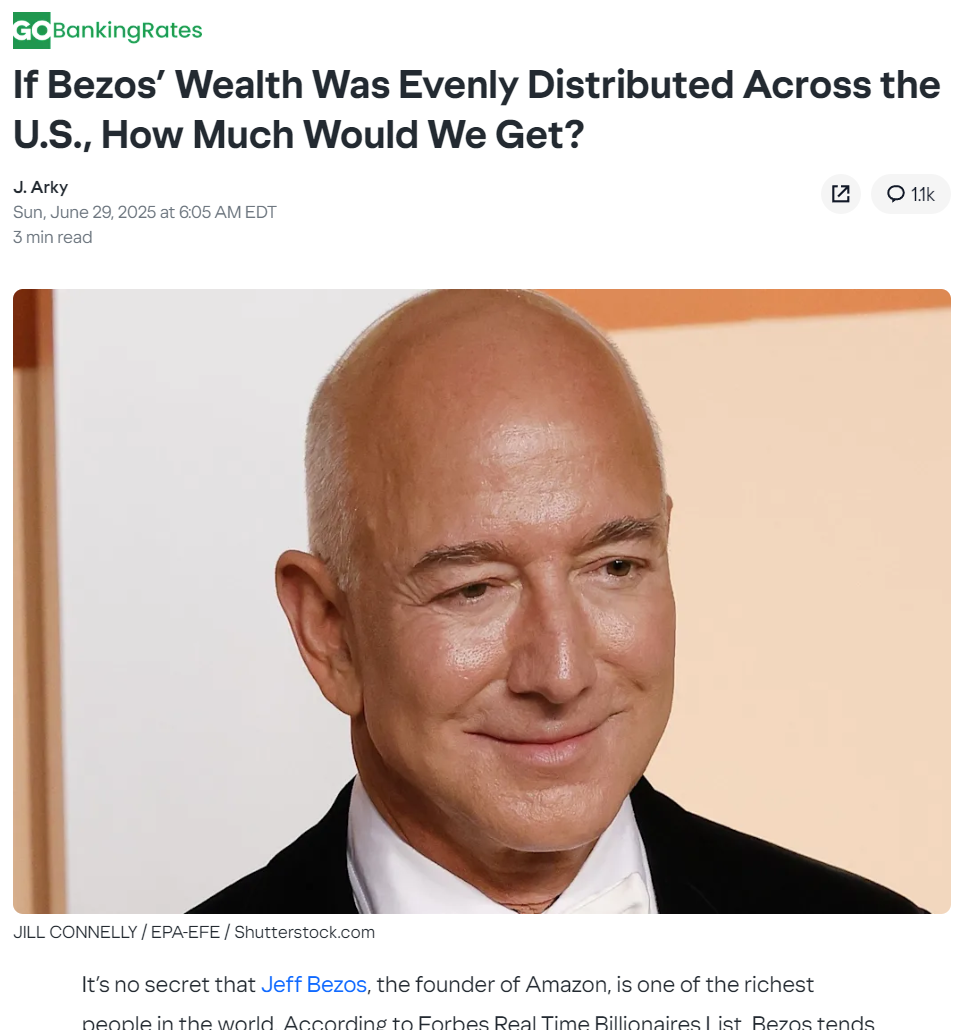
The article explains that we can figure this out using division: $237 billion/341,891,315 = $693 per US resident. Not exactly a life-changing amount.
US federal, state, and local governments run thru about $10 trillion a year, so if we gave it to them, Bezos’s $237 billion would fund them for about a week.
Either way his companies would no longer exist, and the 1.5 million people who work for those companies would lose their jobs. Plus of course no more Amazon packages.
You might wonder – how did Bezos get all that wealth (I won’t say “money” because almost all of it is invested in companies – warehouses, factories, etc.)? Well, he’s one of those super talented people who create giant companies out of little more than talent and work (and of course the work of those 1.5 million people who get paid for helping).
Such people are really rare – there are only a few dozen of them in the world. But when they have large amounts of capital, they can do great things. People with $700 in their pocket can’t do much to change the world. So how about instead we leave the wealth with the single person who has proven that they can do something wonderful with it? Jeff Bezos.
(Plus, you know, he earned it…paid the taxes due and everything.)
Property rights are the difference between the state of nature and civilization
February 12th, 2025
I didn’t say “individual”.
I didn’t say anything about the specific property regime.
This seems relevant in the context of ASI and humans living with them (or not).
Yes, Elon Musk is better than you
January 11th, 2024
Forget Musk’s efforts to save the human race, transition the world from carbon fuels, his other projects. And forget the Gates Foundation’s attempts to end malaria. And Andrew Carnegie’s libraries. Forget philanthropic projects of the wealthy. Or whether those projects are driven by ego or love of mankind. Put all that aside.
Our ancestors lived in caves, infested by parasites, chased by predators, constantly on the edge of starvation. Today we have nice things like indoor toilets and medicine. Electric light, refrigerated food, airliners, the Internet. We didn’t steal that wealth from other cavemen or from space aliens. Wealth isn’t a zero-sum game.
People created those technologies, that wealth. Out of plants and animals, dirt and air, and their own cleverness and work. Who did that? All of us, yes, but a few made vastly larger contributions than others.
Our society is wealthy because of Boulton’s engines, Carnegie’s mills, Vanderbilt’s railroads, Edison’s lights, Gates’ software, and Musk’s cars and rockets. Most of us have always plowed our farms, woven our cloth, done our jobs. And mostly broken even – fed ourselves, raised our children, helped our neighbors survive…and created very little that was new.
But some people are better at creating wealth than others. Just as an Albert Einstein is rare, or a Tiger Woods, or a William Shakespeare is rare, there are a few rare people who are vastly – incredibly – better at creating wealth than most everyone else. Today we call them “billionaires”.
They may not be better than most of us at physics, or golf, or literature, or in any other way, but they have a rare talent for creating wealth. Billionaire’s money (when honestly earned; I exclude crony capitalists and kleptocrats) mostly reflects value created. Value that benefits us all.
Earning a billion dollars is really difficult. See how many try, and how few succeed.
And the living standard at $100 million is virtually identical to that of $100 billion. Most rational people retire when they have enough – long before billionaire status. We are very lucky that a few of these astoundingly productive and capable people keep working – keep chasing dreams, keep creating wealth – long after their personal material needs are satisfied. They made our world, and will make our future.
Sure, Musk makes us look bad. But only in the sense that Mahatma Gandhi does. Nobody should feel jealous of Shakespeare’s writing, Edison’s inventiveness, Einstein’s discoveries. Nor should we resent them for their talent and success. Au contraire; we should celebrate them.
[adapted from a comment on https://fakenous.substack.com/p/elon-musk-is-better-than-you]
Rewards, incentives, and fairness
May 26th, 2017
In a comment on SlateStarCodex today the author (“leoboiko”) advocates a programme of socialism under the assumption that intelligence and ability are inherited, rather than earned, by their possessors. She said,
For one thing, this means that the idea of “meritocracy” is inherently unfair. Giving people access to wealth and resources based on their IQ-related achievements is as unfair as making people richer when they’re born taller. We would want some sort of social program to guarantee everyone access to a decent life according to their needs, not according to their abilities.
And went on to illustrate the unfairness of a world in which wealth was allocated according to height.
I do think intelligence and ability is mostly genetic, and I agree that’s unfair. My response is,
What we are rewarding (and want to reward) is success in helping society progress – materially, culturally, etc. Helping other people. Making the world a better place to live.
Our society is not meritocratic in any sense. We don’t reward merit. Or intelligence. Being meritorious, well-intentioned, hard-working, intelligent, and capable gets you…nothing. What gets rewarded (imperfectly, of course) is actually delivering the result – benefits to other people, as evaluated by those people, by their willingness to voluntarily trade wealth for those benefits.
Intelligence is associated with wealth because we reward pro-social activity, and intelligence makes success in such activity more likely. Height doesn’t (except in basketball).
Steve Jobs wasn’t wealthy because he needed it, or because he was a nice guy (he seems to have been an unpleasant person in many ways). He was wealthy because he created great things that benefited billions of people.
That’s as it should be. It’s not, and never has been, about fairness. It’s about incentives.
Without such incentives, capable people wouldn’t try very hard. And wouldn’t control large amounts of capital for use in their projects. And we all would be far worse off.
Of course I’m not claiming our society does this perfectly or consistently. There are lots of ways to cheat the system, and lots of people who become wealthy in ways other than “making the world a better place” – most obviously, monopolists, tricksters, and power brokers. I advocate fixing that.
But the basic system works. Making the world a better place to live is more important than fairness.